Found this at Take a Bite -
It would[n't] be fair to just say that the iPhone is unsuited for use while driving due to the lack of a keypad without mentioning why it'll be quite comparable to typing on a physical keyboard for sighted people.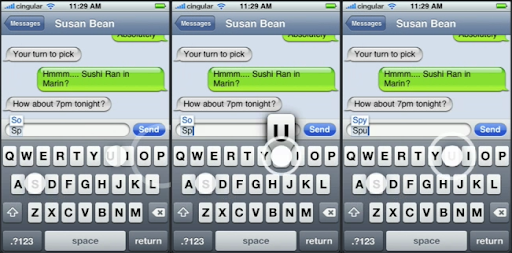
From left to right:
The visual feedback you get from letter magnification combined with 'on release' behavior instead of 'on click' behavior suggest that typing will be a breeze on the iPhone. Multi-touch, or the ability to touch different parts of the display at the same time, means fast two (or more) fingered typing.
----------
I guess the operative word is "sighted" as most teenaged mobile phone users I know these days (except perhaps the ones in the USA) compose SMS text messages without sight - meaning they touch type on the phone's keypad. The phone can very well be in their pocket or their bag. They can even be talking to you, looking at you straight in the eye while their fingers are busy clicking away.
I just don't see how the QWERTY keyboard, on top of the touch feedback, will allow them to replicate the texting experience on the iPhone.
Wednesday, June 27, 2007
An effective finger-based keyboard for the iPhone

How a six-month-old startup got bought by Google
Interesting how-to item from Business 2.0 -
The article discusses the successful efforts of Wayne Crosby and Robby Walker, who co-founded Zenter to develop an online version of Powerpoint. It was bought by Google even while still in private beta. Helpful tips to other entrepreneurs -
- Don't focus on getting acquired. That's like being a single woman who desperately wants to get married. Of course you want it to happen, but 99% of the time if you purposely try to get acquired (or married), it won't. The way to get acquired really fast is to not focus on it. If people get the impression that you want to get bought, you won't.
- Instead, focus on the user. This is possibly the single most important thing for entrepreneurs to remember. "Every startup that dies fails to do this. A lot of startups focus on their competitors or lawsuits, but what really kills startups is if users think it's boring. It's a much quieter and dangerous reason, but if users don't care about your product, that will just kill a company."
- Ignoring limitations lets you tackle problems from a different angle. Zenter looked at how they could build a slideshow application that really takes advantage of the Internet, like adding community slideshows, delivering presentations online in real-time and dragging and dropping content from the web into a presentation. "Every system and every platform has limitations. Some people look at a problem and say, You can't do that because a browser won't let you and proceed to work around those limitations What we (Zenter) did was look at what we wanted to happen and then found a way around the limitations."
- Don't be afraid to tackle the giants. Big companies like eBay and Microsoft may have more manpower and financial resources, but they also have disadvantages. Often times, they're not as driven. They're not willing to make the sacrifice, like two guys sleeping on air mattresses, to make their product really good. Case in point. Google bought YouTube, which was far superior to Google Video. eBay bought PayPal because clearly, no one was liking eBay's Billpoint. Big companies also have restrictions that startups don't have to worry about. E.g. Microsoft has to think about web-based applications that don't threaten Windows. A company like Zenter doesn't care about hurting Windows. All they want to do is make the best application.
- Pay attention to the details. When your product is 80% done, that means you have another 80% to go. To get something pretty close is easy, but you need to concentration on the little things. That's what will set you apart from the competition. You can have the best algorithm in the world and the fastest process, but at the end if the day, if the user struggles to find out how to click a box or delete something, then you don't succeed.
What is Missing from the iPhone
From Engadget, here is a partial list of what is missing from the iPhone -
- There's no way to cut, copy, or paste text! WHOA! Big, big mistake.
- No A2DP support. That, friends, is such a huge bummer right there.
- Sorry, music can't be used as a ringtone -- even if it's just a raw MP3. No additional ringtones will be sold at launch.
- It supports Exchange in some capacity only.
- Document file reading only -- but not editing -- for PDF, Word, and Excel (only).
- Adobe Flash support is officially out. It's just not in the browser. Neither is there any other kind of embedded video support.
- It will take snaps, but won't record video.
- No MMS.
- No voice dialing, either.
- Contact groups can't be emailed as contact lists.
- iPhone battery capacity maxes out at 300-400 charges -- you'll send it in and get the cell replaced for a fee.
- Voice quality is said to be good -- not great.
A horror movie come to life
From The News Tribune -
Three Fircrest, WA families are being terrorized by mysterious mobile phone stalkers who track their every move and occasionally lurk by their homes late at night, screaming and banging on walls.
What makes it frightening is that the police seem unable to help them. In fact, the families say investigators have a hard time believing the stalkers can control their phones without touching them and suspect an elaborate hoax. Complaints to their phone companies do no good, too – the families say they’ve been told what the stalkers are doing is impossible.
It doesn’t feel impossible to the families, who’ve saved and recorded scores of threatening voice mails, uttered in throaty, juvenile rasps stolen from bad horror films. Despite having caller ID on both land lines and mobile phones, "Restricted" always appears on the screen.
The stalkers seem to know every move the families make. They know what they are eating, when the leave the house, even when they go to baseball gams. They know the color of their clothes, they know when the lock on the door was changed. They even threatened shootings at the schools the children attend.
Somehow, they have gained control of the families' mobile phones. Messages received include snatches of conversation overheard on mobile phone mikes, replayed and transmitted via voice mail. Phone records show many of the messages coming from their own phone, even when it is turned off. The stalkers even knew when they visited the police and sent a voice-mail message that included a portion of their conversation with a detective.
The families have blocked the cameras on their phones with tape. They have taken out the batteries to stop the calls. They have returned all their corrupted phones to their telcos and replaced them with new ones. Yet the stalking continues.
Fircrest Police Chief John Cheesman is familiar with the case and knows the families. His department is working the case with the Tacoma Police Department and the Pierce County Sheriff’s Office. The agencies filed a search warrant for the phone records, but they didn’t reveal much. Many of the calls and text messages trace back to one of the families' mobile phone, which is believed to have been electronically hijacked.
According to the U.S. Department of Commerce, mobile phone technology allows remote monitoring of calls. Known as a “roving bug,” it works whether a phone is on or off. FBI agents tracking organized crime have used it to monitor meetings among mobsters. In addition, GPS, available on many phones, also make it possible to pinpoint a phone’s location within a few feet.
According to a Massachusetts-based counterintelligence agent who has advised the U.S. Congress on security issues, it’s not that difficult to take remote control of a mobile phone. “You do not have to have a strong technical background for someone to do this. They probably have a technically gifted kid who probably is in their neighborhood.”
SanDisk First to Offer 6- and 8-Gigabyte microSDHC Cards
From Business Wire -
June 27, 2007 - Sandisk today announced that it is has begun sampling 6- and 8-GB microSD HC memory cards to major phone manufacturers and mobile network operators for testing and evaluation. The new cards are ideal for the growing number of feature-rich multimedia handsets that bring together phones, music players, hand-held computers, digital cameras and more. An 8GB microSDHC card can store more than 2,000 digital songs, or more than 5,000 high-resolution pictures, or up to 5 hours of high-quality MPEG 4 video.
Retail release of the cards and availability to phone manufacturers and network operators are planned for later in 2007. Pricing has not yet been determined.
Wonder if the Asus Eee 701 PC will support this?SMS the iPhone way
With the iPhone getting well over 69 million hits in Google, it is surprising that there is very little discussion on how it deals with SMS texting. Surprising because the iPhone is well a mobile phone. It also does not have a physical keypad. And just as importantly, it processes and presents messages that can be considered a radical departure from the familiar sequential listings in the Inbox, Sent, Log screens established by Nokia.
The iPhone designers are obviously aware that many users often go into texting conversations on the phone, kinda similar to IM chats. So they decided to organize these texting conversations into speech bubbles that can be scrolled back for reference instead of the usual separate Inbox and Sent listings. In addition, mutiple text chats can be stored (by contact name) so that you resume a chain.
This UI will definitely help avid PC IM users transition into text chat on the phone, rather on the iPhone. The question though is just how good is the QWERTY virtual keyboard? I haven't had the chance to do a hands-on but I doubt very much if it can provide a tactile feedback that is often required by users. Personally I feel the keyboard issue will either make or break the iPhone as a mobile phone.
The Hype in iPhone and the Real Test
Give it to Apple to maximize the appeal of its brand cachet. I can’t think of any other tech company which can drum up the media into such a feverish pitch, the New York Times is reporting the iPhone has been the subject of 11,000 print articles and has about 69 million hits in Google. All before its June 29 launch.


